Monday, October 31, 2016

Birthday: "Mulberry Garden, now the only place of refreshment about the town for persons of the best quality to be exceedingly cheated at."

220px-JohnEvelyn1687.jpg

John Evelyn (1620-1706)
Aesthete, author, diarist

Following that most excellent precept, “Choose your parents wisely,” John Evelyn lived a long, tasteful life. His father made a fortune in gunpowder and sent the boy to Balliol College, Oxford, and the Middle Temple. After a brief service on the Royalist side in the English Civil War, Evelyn retreated to the Continent for the duration. He did the Grand Tour, met famous people, and collected tasteful objects, many of which remain in British museums.

Evelyn returned to England and rejoiced in the restoration of the monarchy. He married well, bought an estate in the London suburbs, and set about cultivating its grounds and his mind. He was a prolific author, producing one of the earliest books on air pollution in 1661, and was one of the founders of the Royal Society.

An early conservationist, Evelyn wrote extensively on the care and cultivation of trees. He feared that the growing population and rise of industries like glassmaking would cause the deforestation of the island. His great work on trees, Sylva, was published in 1664 and was in its fourth edition by his death forty years later. His account of the Great Fire of London remains a touchstone for scholars, and he was among those involved with the effort to redesign and rebuild the ruins as a modern capital.

He was a keen observer of manners and social life (his father-in-law was the British ambassador in Paris, and Evelyn moved in court circles); for 65 years beginning in 1641 he kept a diary that, once published in 1818, was the last word on day to day life in 17th century London until his friend Samuel Pepys’ diaries were decoded.

At his death in 1706- at 86, having buried all but one of his eight children- Evelyn had amassed a personal library of over 4600 works that passed through the family until it was finally broken up in eight sales at Sotheby's in 1977-78.

Late in life, Evelyn retired to the family’s country home and inherited the baronetcy at 79. In 1698 he rented his London seat to Peter the Great, Tsar of All the Russias, for three months when the great oligarch came to England to study industry. It was not a happy landlord-tenant relationship:

No part of the house escaped damage. All the floors were covered with grease and ink, and three new floors had to be provided. The tiled stoves, locks to the doors, and all the paint work had to be renewed. The curtains, quilts, and bed linen were ‘tore in pieces.’ All the chairs in the house, numbering over fifty, were broken, or had disappeared, probably used to stoke the fires. Three hundred window panes were broken and there were ‘twenty fine pictures very much tore and all frames broke.’ The garden which was Evelyn’s pride was ruined.

The estate as broken up after Evelyn’s death and remains only- and in small part- as a public park. Evelyn’s Diary has kept his name alive, however; he lives on as a polling station, in the Crabtree & Evelyn skin care line, and, since 1964, as the gossip column of the Oxford University newspaper, The Cherwell.

Sunday, October 30, 2016

Birthday: “Writing is hard. Research is just fun.”


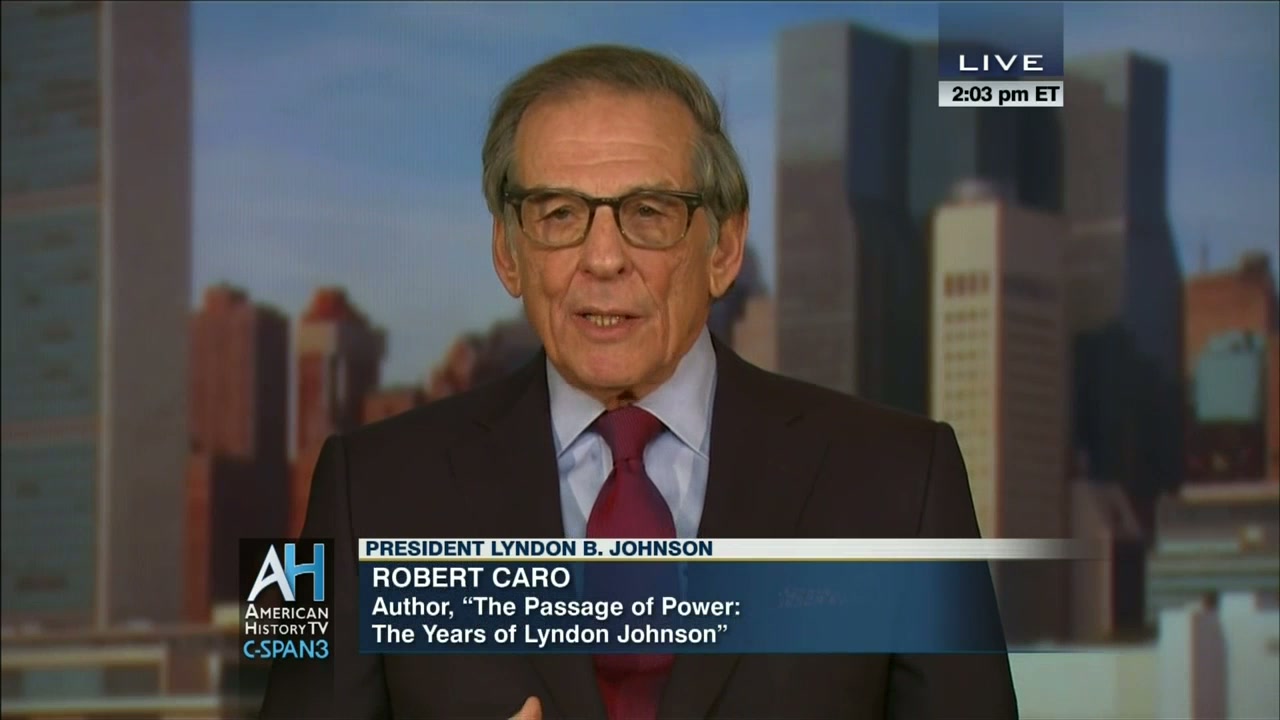
robert caro.jpg

Robert Allan Caro (1935-  )
Biographer

Caro is the last of the 19th-century biographers, the kind who believe that the life of a great or powerful man deserves not just a slim volume, or even a fat one, but a whole shelf full. He dresses every day in a jacket and tie and reports to a 22nd-floor office in a nondescript building near Columbus Circle, where his neighbors are lawyers or investment firms. His office looks as if it belongs to the kind of C.P.A. who still uses ledgers and a hand-cranked adding machine. There are an old wooden desk, wooden file cabinets and a maroon leather couch that never gets sat on. Here Caro writes the old-fashioned way: in longhand, on large legal pads.

That’s how Charles McGrath described Robert Caro in a 2012 profile. Caro, who walked twelve blocks to work every day in the office he set up twenty-six years ago, takes writing seriously, like a job. He bet the farm on his first book, The Power Broker: Robert Moses and the Fall of New York (1974); expecting to knock it out in nine months, he took seven years to see it in print. So parlous were his circumstances that his wife sold their house and took a teaching job to keep them afloat.

Born overlooking Central Park (“He’s a shy, soft-spoken man with old–fashioned manners and an old-fashioned New York accent (he says ‘toime’ instead of ‘time’ and ‘foine’ instead of ‘fine’)”, McGrath wrote), Caro graduated from Princeton with a cum laude degree in English and a thesis on existentialism in the works of Hemingway so long the English Department thereafter imposed a page limit. He worked for newspapers in the New York area, including a six-year stint at Long Island’s Newsday, where he was an investigative reporter:

One of the articles he wrote was a long series about why a proposed bridge across Long Island Sound from Rye to Oyster Bay, championed by Robert Moses, would have been inadvisable, requiring piers so large it would disrupt tidal flows in the sound, among other problems. Caro believed that his work had influenced even the state's powerful governor Nelson Rockefeller to reconsider the idea, until he saw the state's Assembly vote overwhelmingly to pass a preliminary measure for the bridge.

"That was one of the transformational moments of my life," Caro said years later. It led him to think about Moses for the first time. "I got in the car and drove home to Long Island, and I kept thinking to myself: 'Everything you've been doing is baloney. You've been writing under the belief that power in a democracy comes from the ballot box. But here's a guy who has never been elected to anything, who has enough power to turn the entire state around, and you don't have the slightest idea how he got it.'"

The bridge was finally killed in 1973, after nine years of bureaucratic infighting and Moses’ demotion by the only man with more money and power than Moses: New York Governor Nelson Rockefeller.

That experience stuck in his mind for years. Sitting in a lecture on urban renewal, as  Nieman Fellow at Harvard, Caro listened to a professor reciting stats and data on how routes for highways were determined. “That’s not how they do it,” he thought to himself. Roads get built where Robert Moses wants them to get built.”

That led to The Power Broker, the immense biography of the most powerful unelected official Americans never heard of. He leveraged his 1920s idealism for public parks and beautiful highways to get inner city residents out to them, into a tight-fisted rule over New York public works that lasted forty years. Moses built his own power base by becoming a fan of toll roads and bridges, thus creating his own revenue sources and ability to issue bonds for more, bigger projects out of his unelected bridge and highway commissions and authorities.

By the 1960s, Moses’ vision seemed to be crumbling about him: American cities were becoming empty shells, and Moses pioneered broad-brush urban renewal: wholesale elimination of entire neighborhood to make way for bigger roads and vanity projects like New York’s Lincoln Center, which cleared 17 acres of apartment buildings and businesses in a stroke.

The Power Broker was an earthquake disguised as a 1250 page doorstop. The New Yorker serialized a hundred thousand words from its 350,000. The 1975 Pulitzer Prize was given for it. It remains so influential  book that a fortieth anniversary edition was published to acclaim in 2014.

Caro then turned his attention to the recently-deceased American president, Lyndon B Johnson. He signed a contract with Random House for a biography. By then he’d grown fascinated with the theme of power:

Caro’s obsession with power explains a great deal about the nature of his work. For one thing, it accounts in large part for the size and scope of all his books, which Caro thinks of not as conventional biographies but as studies in the working of political power and how it affects both those who have it and those who don’t. Power, or Caro’s understanding of it, also underlies his conception of character and structure. In “The Power Broker,” it’s a drug that an insatiable Moses comes to require in larger and larger doses until it transforms him from an idealist into a monster devoid of human feeling, tearing down neighborhoods, flinging out roadways and plopping down bridges just for their own sake. Running through the Johnson books are what Caro calls “two threads, bright and dark”: the first is his naked, ruthless hunger for power — “power not to improve the lives of others, but to manipulate and dominate them, to bend them to his will” — and the other is the often compassionate use he made of that power. If Caro’s Moses is an operatic character — a city-transforming Faust — his Johnson is a Shakespearean one: Richard III, Lear, Iago and Cassio all rolled into one. You practically feel Caro’s gorge rise when he describes how awful Johnson was in college, wheeling and dealing, blackmailing fellow students and sucking up to the faculty, or when he describes the vicious negative campaign Johnson waged against Coke Stevenson. But then a volume later, describing Johnson’s championing of civil rights legislation, he seems to warm to his subject all over again.

The hallmark of Caro’s work is research. He takes as long as it takes to do it, and, as a result, finds things. In The Power Broker, he discovered, and interviewed, a poor brother Robert Moses had utterly airbrushed from his life. He has spent years at the LBJ Presidential Library, from which he has sifted so much of the historical record that McGrath says,

In his years of working on Johnson, Robert Caro has come to know him better — or to understand him better — than Johnson knew or understood himself. He knows Johnson’s good side and his bad: how he became the youngest Senate majority leader in history and how, by whispering one thing in the ears of the Southern senators and another in Northern ears, he got the Civil Rights Act of 1957 through a Congress that had squelched every civil rights bill since 1875; how he fudged his war record and earned himself a medal by doing nothing more than taking a single plane ride; how, while vice president during the Cuban missile crisis, his hawkishness scared the daylights out of President Kennedy and his brother Robert. Caro has learned about Johnson’s rages, his ruthlessness, his lies, his bribes, his insecurities, his wheedling, his groveling, his bluster, his sycophancy, his charm, his kindness, his streak of compassion, his friends, his enemies, his girlfriends, his gofers and bagmen, his table manners, his drinking habits, even his nickname for his penis: not Johnson, but Jumbo.

That indefatigability has had its downsides. Former LBJ press secretary has refused Caro interviews for decades. Johnson’s widow gave him a few before freezing him out of her circle. Though Johnson Library staff think him family, the Johnson family never invite him to Library conferences on the LBJ legacy.

2016 marks forty years Caro has spent on The Years of Lyndon Johnson- longer than Johnson’s actual public life- and he is still researching what is supposed to the the fifth and final volume. Each one emerges at seemingly random intervals, like the seasons of the cable series Mad Men: the first came out in 1982; volume 2 took eight more years. The third book took twelve; the fourth, ten. Caro is eighty-one today; his editor since The Power Broker, is 85-year-old Robert Gottlieb. McGrath concludes,

Caro has taken so long with Johnson that his agent, Lynn Nesbit, no longer remembers how many times she has renegotiated his contract; his publishing house has had two editors in chief, and no one there worries much about his deadlines any longer. The books come along when they come along. “I’m not a charity case,” Caro pointed out to me last month when I remarked on how Knopf had stuck by him all these years. It’s true that the Johnson volumes have been glowingly reviewed (“The Path to Power” and “Means of Ascent” both won the National Book Critics Circle Award and “Master of the Senate” won the Pulitzer Prize and the National Book Award) and that each of them has been a best seller, but it’s also true that they turn up so infrequently that Caro can hardly be thought of as a brand name. “Are the books profitable?” Sonny Mehta, Knopf’s current head, who took over the Johnson project — enthusiastically — after Gottlieb’s departure in 1987, said last month. He paused for a moment. “They will be,” he answered finally, “because there is nothing like them.”

Gottlieb is more philosophical. “So what if at the end of 45 years it turns out we lost money by one kind of accounting?” he said. “Think of what he has given us, what he has added. How do you weigh that?”

With two Pulitzers, three National Book Critic Awards, the Gold Medal of the American Academy of Arts & Letters, the Francis Parkman, Carl Sandburg and John Steinbeck Prizes, the National Medal of the Humanities, and scores of lesser gongs, Caro just shows up for work every day, quietly racing the clock, and says he has his next subject picked out.
Birthday Book of the Day: Before reality TV, the thing to have was a radio program


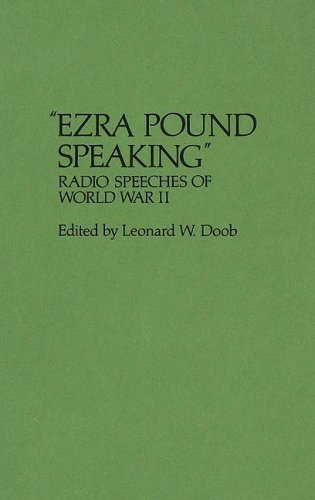
145105.jpg

Doob, Leonard W., ed., “Ezra Pound Speaking”: Radio Speeches of World War II (Greenwood Press, Contributions in American Studies, #37, 1st ed., 1st printing, 1978). ISBN 0-313-20057-2. The foreword says, “The best reason for publishing Ezra Pound’s Italian broadcasts may be the simplest. Thousands of people have heard about them, scores have been affected by them, yet but a handful has ever heard or read them. Here they are.”

Since his death in 1972, Ezra Pound- born on this day in 1885- has slipped into history’s embrace and many people do not much know, or appreciate, the influence he possessed before World War II or the controversy he caused after it. Far from the sunny, affably clueless radio postcards of P.G. Wodehouse, Pound had an agenda and he was determined to push it. Fascist radio was all too happy to help. This book is a singular contribution to the history of the war era and understanding the life of Ezra Pound in all its complexities and contradictions. Hardcover, no dustjacket as issued, Green boards, fine condition. Octavo, 465 pp. HBB price: $50 obo.


Henry Bemis Books is one man’s attempt to bring more diversity and quality to a Charlotte-Mecklenburg market of devoted readers starved for choices. Our website is at www.henrybemisbookseller.blogspot.com. For more information about any listed book, or more photos, please contact Lindsay at henrybemisbookseller@gmail.com. Henry Bemis Books is also happy to entertain reasonable offers on items in inventory. Shipping is always free; local buyers are welcome to drop by and pick up their purchases at our location off Peachtree Road in Northwest Charlotte if they like. #RareBooks #HenryBemisBooks #EzraPound #RadioBroadcasts #FirstEditions

Friday, October 28, 2016

The Boston International Antiquarian Book Fair is this weekend!

Maine bookseller Ian Kahn gives a tour of his booth in Boston:


Birthday: "Manners are especially the need of the plain. The pretty can get away with anything," Evelyn Waugh said.

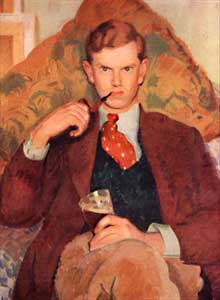
waugh1.jpg
Waugh, in 1929, by Henry Lamb

Arthur Evelyn St. John Waugh (1903-1966)
Author

“Evelyn,” he was known- with a long ‘e’- was the son of a publisher and managed to become one of the most skilled writers, and loathed human beings, in 20th-century British literature.

Waugh was raised in the then-rural London suburb of Golders Green; at a boys school he honed his skills as a bully to such an edge that the photographer Cecil Beaton spoke ill of him decades later. He aimed to go to Sherbourne, the public school his father and older brother, Alec, attended, but Sherburne turned him down flat. Alec- who went on to become a successful novelist- had got himself sent down for a homosexual affair and had his revenge on the school by writing a thinly-disguised novel about it. No more Waughs, declared Sherburne, and Waugh went to Lancing, which he considered vastly inferior but where he soon found his footing as an aesthete and budding writer.

He won a history scholarship to Hertford College, Oxford. He viewed the money as an award for past, rather than future achievement, and cultivated various dissipations. “I drank for Hertford,” he said of his interest in college sports. In 1922 he fell in with a gaudy crowd of stylish boozy gay men, led by the future writer Harold Acton, and cheerfully upped his drinking during a series of gay relationships. His behavior got the notice of his tutor, one Crutwell, who called him on the carpet; Waugh, offended by the suggestion, formed a lifelong animus toward his prof and used his surname for a series of “ludicrous, ignominious or odious minor characters” in his future books.

Waugh lost his scholarship, which made it impossible to complete his degree; he left Oxford in 1924 and took up teaching in boys’ schools (In his breakthrough novel, Decline and Fall, the hero, sent down for running, pantsless, across the college commons, is told by the porter as he leaves, “I expect you’ll take up school mastering, sir. That’s what most young men does that gets sent down for depravity.”.

While teaching, he thought he had a line on a cushy new job, and sent his first novel off to Acton for a read-through. The job fell through, Acton was dismissive of the book, and Waugh decided to kill himself by drowning. Wading into the sea, he was stung by a jellyfish, thought better of the enterprise, retrieved his clothes, and moved to London to write.

Starving as a writer, Waugh fell in love with a peer’s daughter, also named Evelyn. They married in 1928, over her parents’ objections- they thought he ran with bad people and lacked moral fibre, and they were right- but he ended up divorcing she-Evelyn for adultery in 1929.

In the meantime, Waugh’s spec bio of Rossetti was a critical success, and Decline and Fall, a financial one. Waugh commanded good fees as a journalist and embarked on decade of constant travel punctuated by dossing down in the country homes of his ever-more prominent friends. After his divorce, Waugh assumed a sharper edge in his satirical writing and hs judgments of people, already pretty savage. In 1930 he converted to Catholicism, becoming a particularly retrograde and condescending sort, and acquiring a new enemy in the process. Almost immediately his 1931 novel, Black Mischief, got him denounced by the church press, The Tablet, for blasphemy. He responded with an open letter to the Archbishop of Westminster so sharp it was suppressed until 1980.

In the ‘30s Waugh traveled a lot in Africa, taking notes for what would become his hilarious novel of journalism and foreign correspondents, Scoop. He married Laura Herbert, daughter of an explorer, in 1937; her grandmother bought them a house in the country. He fell easily into the role of country squire and continued mining his personal experiences for his books.

When the war came, Waugh volunteered for the Royal Marines, then got a transfer to the Horse Guards. He was sent lots of places, but never saw action; he was so naturally insubordinate there was no making a soldier of him. The Guards must have breathed a sigh of relief when he requested a three-month leave to write what became Brideshead Revisited; he managed to continue the leave well into 1944 before being called back and sent to Yugoslavia on a political/military mission with the Prime Minister’s son, Randolph Churchill. The two had a love-hate relationship for decades; Waugh accused Churchill of asking Waugh to autograph books for him so Churchill could resell them; when Churchill had surgery for a non-cancerous growth, Waugh exclaimed that the wonder of modern medicine was that doctors could find the only non-malignant part of Randolph and remove it.

The mission provided Waugh with more material for his books; he wrote a report on the trip that the Foreign Office suppressed to avoid an international incident with the post-war dictator there, Josip Tito.

Brideshead, published in 1945, was probably Waugh’s high point as an author. At fifty he suffered a nervous breakdown, which- with his legendary detachment, he turned into a novel, The Ordeal of Gilbert Pinfold- and presided, with dismay, over his seven children. In 1956 a tabloid writer appeared on his doorstep, demanding an interview; the subsequent story claimed Waugh was dried up as a writer and barely making any money for his articles. Waugh- thin-skinned as ever- sold the house (“it felt polluted after that”) and got a libel judgment against both paper and reporter. His finances were constantly pressed by the high postwar tax rates; the more books he sold, the more he owed, and his newfound taste for collecting- and writing about- art, pushed his expenses ever upward.

Waugh affected a self-mocking decrepitude even as he took on more work to pay the taxman, keep the kids in private schools, maintain the house, and indulge his fondness for drink as the cure for depression and insomnia. He was having trouble with his hearing, his teeth, his eyesight, he complained. He gave spiky interviews to the BBC, affecting the most cynical and reactionary airs he could (he once posed for a photo using an ear-trumpet). It was not a stretch; posthumous publication of his letters and papers revealed him for an enthusiastic anti-semite, racist and homophobe.

He died after attending Mass in 1963 and was buried outside the Anglican graveyard in the village where he lived. After Waugh’s death, he experienced a career revival; the quality of his work began to be appreciated in the fullness of time, and the publication of his letters in 1980 made for plenty of controversy, full as they were of remarkable mean spiritedness and a goofily antic side most often on display in gossipy reports to his bosom friends, the Mitford sisters. Philip Larkin, reviewing the collection in The Guardian, thought that it demonstrated Waugh's elitism; to receive a letter from him, it seemed, "one would have to have a nursery nickname and be a member of White's, a Roman Catholic, a high-born lady or an Old Etonian novelist".

The BBC production of Brideshead Revisited in 1982 won Waugh a new following among Reagan-era Anglophile conservatives who adopted him- the post-Oxford, no-longer-gay Waugh, that is- as a tutelary figure. No less an embodiment of American Waughism than William F. Buckley, Jr. (whom Waugh dissed in his letters; the thin-skinned Buckley wrote the book’s editor to complain that none saying nice things about Buckley were included, with a copy to Waugh’s son) served as host of the PBS showings of the series.

Waugh’s son, Auberon (1939-2001) made a great career as a writer and journo in own right, inheriting his father’s sharp wit and sense of satire. The Literary Review’s annual Bad Sex in Fiction Awards is one of the younger man’s legacies.

Every day is a literary birthday at www.henrybemisbookseller.blogspot.com. Drop in; don a party hat!

Thursday, October 27, 2016

SOLD!

For the Clemson memorabilia collector on your football season’s back-list, a rare cookbook, half price:

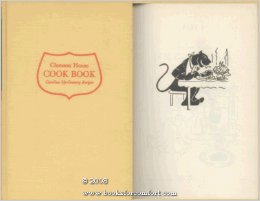
clemson house.gif

Paget, Russie H., The Clemson House Cookbook (Jacobs Brothers, 1st ed. 1955). Built in 1950 as a hotel and conference center, Clemson House’s cuisine inspired this 474 pp cookbook. Part I is of Heirloom Recipes from the South Carolina Upstate region; Part II is made up of Contemporary Recipes- Native and Foreign. Illustrations include a hungry tiger at the dinner table, leaning over his plate, knife and fork in paws; at the end, he’s leaning back, tum bulging, looking quite sated. A delightful regional work. Hardcover, no dustjacket, some staining and wear but overall in good condition. Rare. HBB price: $39.95.

Birthday: A very literary president


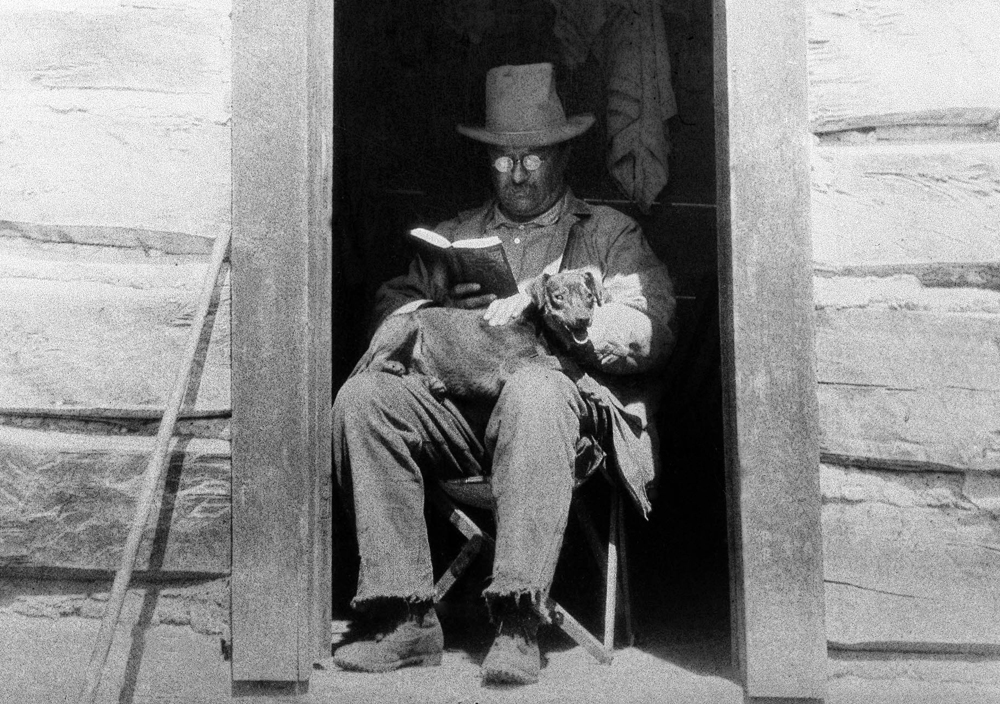
roosevelt reading.jpg

Theodore Roosevelt Jr. (1858-1919)
Author, public figure

He was born, he said, to be one of the governing class. At 24, he had published his first book, joined the New York National Guard, and been elected to the State Assembly. At 28, he’d become a father, lost his wife in childbirth and most of his fortune in a western ranching venture, and run for mayor of New York. He made most of his living, for the rest of his life, as a writer, both of books and periodical articles. By the time he died, not quite three months after his 60th birthday, he had published 37 books in 36 years.

In between books (and an estimated 150,000 letters), he remarried, fathered five more children, served on the US Civil Service Commission; as New York Police Commissioner, Assistant Secretary of the Navy, colonel in a cavalry regiment in the Spanish-American War, governor of New York, Vice President of the United States for 195 days, President for seven and a half years and a candidate for a third term in 1912 (he took time off, mid-campaign, to defend a libel suit and recover from an attempted assassination), and winner of the Nobel Peace Prize.

One of this last books, A Book Lover's Holiday in the Open (1916) has nothing to do with books, except that, in the preface, he explains how he can still offer frontier adventures and exploits to milksops grown old before their time and reduced to reading books like his.

Roosevelt remains the most-published author of America’s 44 presidents, though with thirty books to his name, former President Jimmy Carter is closing the gap fast. From the Theodore Roosevelt Association’s website, here is President Roosevelt’s bibliography:

1882 The Naval War of 1812

1885 Hunting Trips of a Ranchman

1887 Thomas Hart Benton

1888 Essays on Practical Politics,
Gouverneur Morris
Ranch Life and the Hunting Trail

1889-96 1896 The Winning of the West, 4 vols.

1891 New York

1893 The Wilderness Hunter

1895 Hero Tales from American History (with Henry Cabot Lodge)

1897 American Ideals
Some American Game

1899 The Rough Riders

1900 The Strenuous Life
Oliver Cromwell

1905 Outdoor Pastimes of an American Hunter

1907 Good Hunting

1909 Outlook Editorials

1910 African and European Addresses
African Game Trails
American Problems
The New Nationalism

1912 The Conservation of Womanhood and Childhood Realizable Ideals

1913 Autobiography, History as Literature and Other Essays
Progressive Principles
Through the Brazilian Wilderness

1914 Life-Histories of African Game Animals 2 vols., co-author with Edmund Heller

1915 America and the World War

1916 Fear God and Take Your Own Part
A Book Lover's Holiday in the Open

1917 The Foes of Our Own Household
National Strength and International Duty

1918 The Great Adventure

Note: Theodore Roosevelt was co-editor with George Bird Grinnell and contributed to three books published by the Boone and Crockett Club: American Big-Game (1893), Hunting in Many Lands (1895), and Trail and Campfire (1897). TR, T. S. Van Dyke, D. G. Elliot, and A. J. Stone were the contributors to the The Deer Family (1902).