Here's this week's LGBookT: https://t.co/EAI9yLm38C pic.twitter.com/oIa52g0CAe
— Henry Bemis Books (@henrybemisbooks) April 13, 2018
Thursday, April 12, 2018
Here's this week's dose of the subversive!

Book of the Day: Parallel Cities

“What’s going on with Charlotte?” friends ask me on social media and by email.
It’s a good question. Charlotte has ever striven for a quiet pride in itself, a city of banks and the churches in which the bankers worshiped, of NASCAR and sports and a vague progressivism that translates to, “We’re not as bad as [Southern City of Your Choice].”
As the Queen City competes for the next Republican convention, local debate is focused on inequality- in housing, jobs, and education.
How did we get here?
Alan Pyke’s article, in Think Progress, is a good summary of how, displaced from power for twenty years at the end of the 19th century, North Carolina’s old guard got it back and cemented itself in. In Charlotte, the effects of segregation laws were amplified by ban’s financing practices and developers’ restrictions on land as the city began its relentless, decades-long surge outward.
And then, in the 1950s and ‘60s, city leaders embraced new roads- a social engineering tool for the days of Baron Haussmann in Paris through Robert Moses in New York and his baleful influence jamming interstates through cities.
In Charlotte, “problem communities” were simply paved over with federal highway and urban renewal money. And as Thomas Hanchett wrote in his book, Sorting Out the New South City, thousands of suddenly displaced families had to move to where there was somewhere to live, never mind that it was usually a step or two down, and further out:
Map today’s steeply segregated Charlotte by racial demographics and you’ll get something that looks like Pacman’s silhouette running downhill. The white populace is heavily concentrated within one triangular slice of the city’s south end, between South Boulevard and Providence Road.
Neighborhoods there are 80 to 95 percent white. Wind clockwise around the city’s face from South Boulevard, however, and you’ll be hard-pressed to find census tracts where the white population even cracks 30 percent.
These are the domain of Charlotte’s black folk, neighborhoods that cling to the sides of the giant interstates that chisel the city apart from itself.
I-77 blades north and south through town, its shadows harboring almost all-black neighborhoods.
Its twin monster, I-85, slithers east-west across the city. On the west side, dozens of minority-majority communities cling to 85’s hips.
Thomas Hanchett’s Sorting Out The New South City- on which Pyke’s article relies- is to Charlotte what Robert Caro’s The Power Broker was for New York under Moses. He documents how the city became two.
Henry Bemis Books is pleased to offer an autographed copy of this important and newly-timely work:
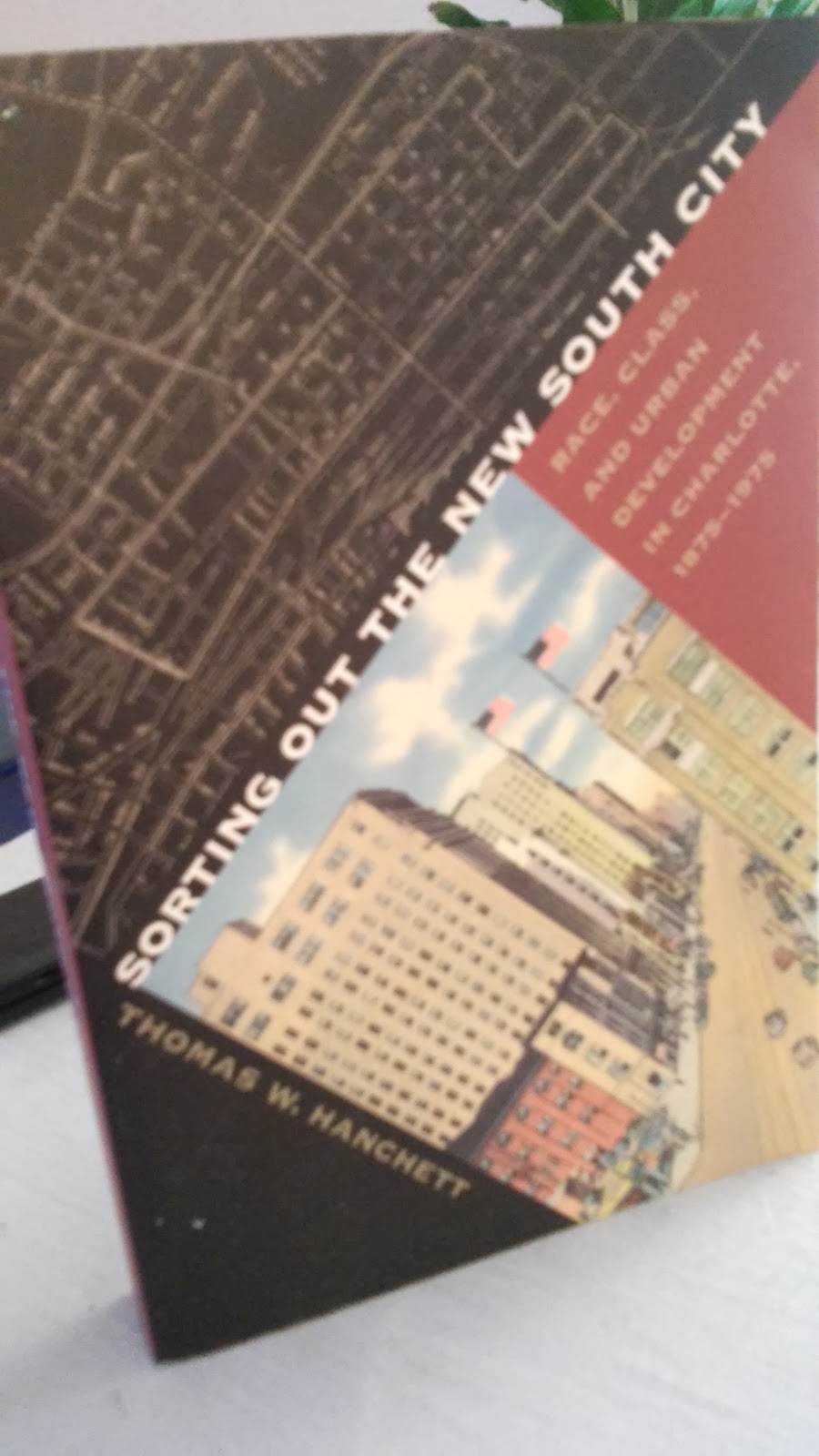
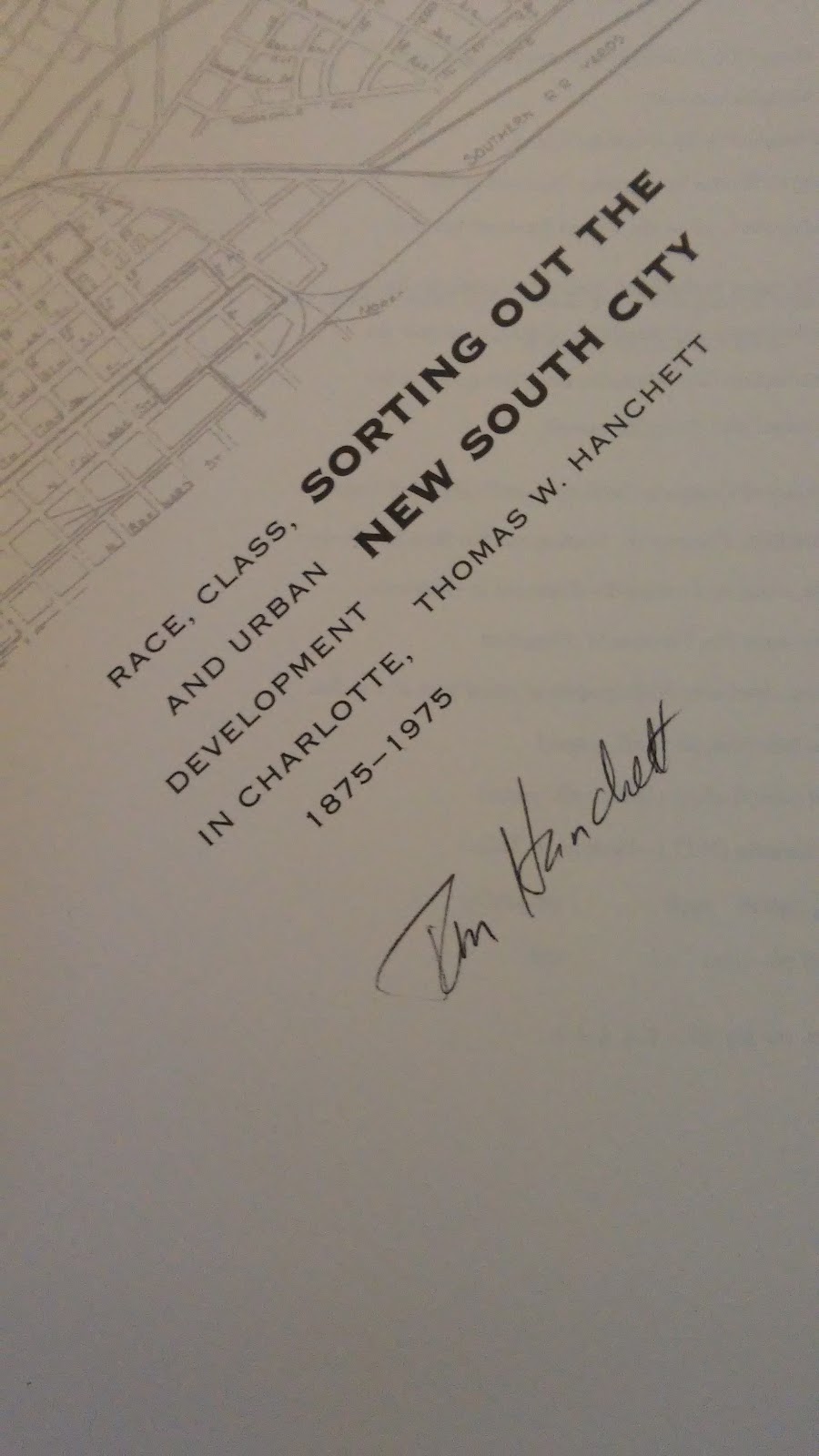
Hanchett, Thomas W., Sorting Out the New South City: Race, Class, and Urban Development in Charlotte, 1875-1975 (UNC Press, 1st ed., 1st printing, 1998). ISBN 0-8078-4677-5. Fascinating account of how Charlotte did not begin as a deliberately segregated city, but became one over time, through the rise of large manufacturing companies, new travel technologies, and- finally- urban renewal finding, which allowed civic leaders to resort the city’s residents on opposite sides of the city. Trade paperback, 9.25” x 6”, 380 pp. Very good condition. Autographed on the title page. HBB price: $50 obo.
#ThomasHanchett #SortingOutTheNewSouthCity #FirstEditions #Autographs #RaceandPolice #HenryBemisBooks #Charlotte
This week in literary trivia-
In 1904 the Nobel Prize in Literature was split between two authors for the first time. Find out more in this week's Gallimaufry! https://t.co/oa4jJFsjHJ pic.twitter.com/SezWEcCsao
— Henry Bemis Books (@henrybemisbooks) April 12, 2018
Tuesday, April 10, 2018
The Great Gatsby is 93 today!
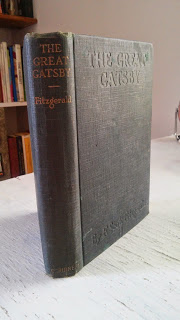
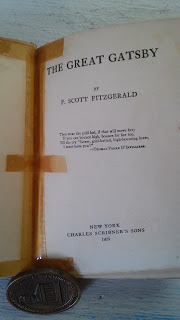
Today in 1925, The Great Gatsby was published for the first time. Henry Bemis Books is offering a first edition hardcover copy of the F. Scott Fitzgerald classic.
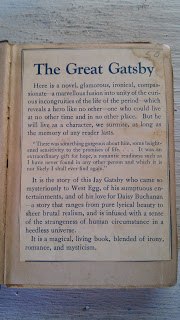
Our Gatsby has the first edition points, but lacks the dust jacket (if it had that, I’d be on a beach in Honduras already), and has a couple of condition issues: some loose pages and a cellophane tape repair to the title page. The front and back insides of the dust jacket are pasted inside the boards. The gold lettering on the outer boards is still good. Only 23,000 copies made up the first edition; when Fitzgerald died in 1940, there were unsold copies in the Scribner warehouses. 90+ years on, only a tiny number survive, in any condition.
HBB price: $250.
Henry Bemis Books is one man’s attempt to bring more diversity and quality to a Charlotte-Mecklenburg market of devoted readers starved for choices. Our website is at www.henrybemisbookseller.blogspot.com. Henry Bemis Books is also happy to entertain reasonable offers on items in inventory; for pricing on this or others items, kindly private message us. Shipping is always free; local buyers are welcome to drop by and pick up their purchases at our location off Peachtree Road in Northwest Charlotte if they like.
What’s your favorite social media outlet? We’re blogging at www.henrybemisbookseller.blogspot. com. We tweet as Henry Bemis Books. Have you liked us on Facebook yet? Henry Bemis Books is there, too. And Google+!
#Fitzgerald #The GreatGatsby #FirstEditions #HenryBemisBooks #Charlotte
Monday, April 9, 2018
We're doin' Hannukah, in Santa Monica-
Today's the 90th birthday of one of America's great songwriters, Tom Lehrer. Enjoy some of Henry's music offerings! https://t.co/7Yo8iCkUjm pic.twitter.com/ogprZJNp7n— Henry Bemis Books (@henrybemisbooks) April 9, 2018
Saturday, April 7, 2018
Golf Books of the Day: As Nick Faldo says, " "The course is perfection, and it asks perfection."
The Masters began today. It’s the first in a very long time without Arnold Palmer.
It’s surely one of America’s premier sporting events, and even those who wouldn’t know a mashie niblick outside an Agatha Christie novel have surely watched some of it, some years, just to see the perfection of the landscape carved out of Georgia farmland.

Henry Bemis celebrates The Masters with four classics:


Green, Ron, Shouting At The Amen Corner: The Masters- Dispatches from the World’s Greatest Greatest Golf Tournament (A SportsMasters Book, Sports Publishing Inc., 1999, 1st ed.). ISBN 1-58382-018-3. Charlotte Observer columnist collects 45 years of Masters articles. Hardcover, unclipped dust jacket, very good condition, autographed. HBB price: $25.


Love III, Davis, Every Shot I Take: Lessons Learned About Golf, Life, And A Father’s Love (Simon & Schuster, 1st ed., 2nd printing, 1997). ISBN 0-684-83400-6. Memoir by the popular professional golfer, inscribed on the end papers. Hardcover, octavo, 204 pp., unclipped dust jacket. Very good condition. HBB price: $24.99.

Ouimet, Francis, A Game of Golf: A Book of Reminiscence (1932, limited ed. by The Old Golf Shop, Cincinnati, 1978, No. 57 of 250). 20 year old former caddie and unknown amateur Francis Ouimet stunned the sports world by beating the godlike Harry Vardon in the 1913 U.S. Open, making the front page of the New York Times in the process. Ouimet (1893-1967) changed the perception of golf as the game for the super-rich and became a beloved figure in golf through the decades. This very limited edition is part of an annual series reprinting of books by the honoree of the annual Memorial Tournament, started in 1976 to honor those- living and dead- who did the most to advance the sport. A very rare edition of an excellent autobiography. Green boards with gilt edging and titles, no dust jacket, very good condition. 8.75” x 5.75”, 274 pp. HBB price: $175.
Sarazen, Gene, with Herbert Warren Wind, Thirty Years of Championship Golf (1950, limited ed. by The Old Golf Shop, Cincinnati, 1979, No. 109 of 260). Sarazen (1902-99) was one of the world’s best golfers in the 1920s and ‘30s, and one of the five pro golfers to win the Grand Slam. The book recalls his remarkable career. This very limited edition is part of an annual series reprinting of books by the honoree of the annual Memorial Tournament, started in 1976 to honor those- living and dead- who did the most to advance the sport. A very rare edition of an excellent autobiography. Green boards with gilt edging and titles, no dust jacket, very good condition. 8.75” x 5.75”, 276 pp. HBB price: $75.
Henry Bemis Books is one man’s attempt to bring more diversity and quality to a Charlotte-Mecklenburg market of devoted readers starved for choices. Our website is at www.henrybemisbookseller.blogspot.com. Henry Bemis Books is also happy to entertain reasonable offers on items in inventory; for pricing on this or others items, kindly private message us. Shipping is always free; local buyers are welcome to drop by and pick up their purchases at our location off Peachtree Road in Northwest Charlotte if they like.
What’s your favorite social media outlet? We’re blogging at www.henrybemisbookseller.blogspot. com. We tweet as Henry Bemis Books. Have you liked us on Facebook yet? Henry Bemis Books is there, too. And Google+!
#Golf #TheMasters #FirstEditions #Autographs #HenryBemisBooks #Charlotte
Here's today's Rare Book Cafe program!
Today, @RareBookCafe welcomed Amber Shehan of @Biblio_com, a sponsor of this year's @FloridaBookFair, and author @historian2pac Lee Irby, who is SO OVER book tours! https://t.co/mcRAkUa9G0 pic.twitter.com/rCsFJ1Fn6n
— Henry Bemis Books (@henrybemisbooks) April 7, 2018
Friday, April 6, 2018
News they say you shouldn't know.
This week's LGBookT: law-unto-herself clerk Kim Davis's book; the battling bunny books bag a former FBI director as an easter egg; was The Wind & The Willows just a prequel to The Boys in The Band?; and remembering Swinburne and Samuel Delany.https://t.co/kXXhoM7pBo pic.twitter.com/VMzXhGkOGW— Henry Bemis Books (@henrybemisbooks) April 6, 2018
Was Ezra Pound crazy? Does it matter any more? Read his words yourself.

Doob, Leonard W., ed., “Ezra Pound Speaking”: Radio Speeches of World War II (Greenwood Press, Contributions in American Studies, #37, 1st ed., 1st printing, 1978). ISBN 0-313-20057-2. The foreword says, “The best reason for publishing Ezra Pound’s Italian broadcasts may be the simplest. Thousands of people have heard about them, scores have been affected by them, yet but a handful has ever heard or read them. Here they are.” Since his death in 1972, Ezra Pound- born on this day in 1885- has slipped into history’s embrace and people do not much know the influence he possessed before World War II, or the controversy he caused after it. Far from the sunny, affably clueless radio postcards of P.G. Wodehouse, Pound had an agenda and he was determined to push it. Fascist radio was all too happy to help. This book is a singular contribution to the history of the war era and understanding the life of Ezra Pound. Hardcover, no dustjacket as issued, Green boards, fine condition. Octavo, 465 pp. HBB price: $50.
*****
Sixty years ago this month, the American poet Ezra Pound was released from a federal mental hospital after thirteen years’ confinement and a near-trial for treason after World War II.
How to square his personal and political views with his poetic genius is as vexing as loving Wagner’s music but hating his similar hates is to operaphiles. Reviewing a new book on Pound, The Nation notes that, as Pound faced trial for his Italian radio rants,
Here, another strategy was necessary. Pound had clearly forfeited the role he’d long cultivated, as the visionary leader of a political and cultural vanguard. But perhaps he could be presented as another, equally familiar archetype: the brilliant poet touched by madness.
Was Pound really mentally ill? Or had he been faking it all along? In his influential The Roots of Treason: Ezra Pound and the Secret of St. Elizabeths (1984), the psychiatrist E. Fuller Torrey claimed that Pound’s lawyer, Julien Cornell, in cahoots with Dr. Winfred Overholser, the superintendent of St. Elizabeths, conspired to present an eccentric and egocentric but essentially sane individual as a madman in order to preserve his reputation and, possibly, save his life.
It’s true that, if convicted, Pound could well have faced the death penalty: A number of fascist and Nazi collaborators, including Britain’s William Joyce, Norway’s Vidkun Quisling, and France’s Pierre Laval, were executed for treason by their home countries. Cornell decided early on that having his client declared mentally unfit to stand trial was the wisest course. The gambit worked: The jury at Pound’s sanity hearing took only four minutes to decide that the poet was “of unsound mind.”
The price of Pound’s survival, as Swift sees it, was a public renunciation of his authority as a writer and thinker. Having spent decades setting himself up as an expert not only in literature but in politics, economics, history, anthropology, and Sinology, among other fields, Pound was now admitting that he lacked the mental competence to stand trial. The Cantos was meant to be “a poem containing history” that synthesized all Pound knew and believed into an epic masterpiece that would help put civilization on the right track in the 20th century. Now it was used as an exhibit demonstrating its author’s incoherence.
Before Pound’s sanity hearing, Cornell presented extracts from The Cantos that the poet had composed during his incarceration in Pisa to four expert psychiatrists as “evidence of his mental condition.” On the stand, one of them, Dr. Wendell Muncie, testified that, on the evidence of this and Pound’s other writings, he judged that “there has been for a number of years a deterioration of the mental processes.” Here was Pound’s own putative masterpiece held up as proof of his disintegration.
A facinating audio re-enactment of the Pound programs, from Doob’s book, is here:
#RareBooks #HenryBemisBooks #EzraPound #RadioBroadcasts #FirstEditions
Thursday, April 5, 2018
Book of the Day: Lucky Lindy, fictionalized

John Duffield, aka Franklin W. Dixon, Over the Ocean to Paris (Grosset & Dunlap, 1927, circa 1930 printing). Hardcover, red cloth boards as with all the titles in the series. Black stamped title, author name and, on the cover, a Spirit of St Louis lookalike plane. Inscribed on the front endpapers, “David from Barbara, on your 10th birthday.” With one frontispiece b&w illustration, “He Was Flying Directly Over Paris.” HBB price: $20.
One of America’s most innovative children’s and young adult publishers, Franklin Stratemeyer, loved nothing better than adventure tales with lots of shiny new technology. For nearly a century, Stratemeyer’s hired writers churned out stories involving heroes he invented: the Hardy Boys, Tom Swift, Nancy Drew, The Rover Boys, and dozens of others.
By the 1920s- when the Ted Scott Flying Series launched- over 80% of all juvenile fiction read in America were a Stratemeyer title.
In the first book in the sixteen-year, 21-book series, Over the Ocean to Paris published in 1927, Ted Scott achieved fame for being the first pilot to fly over the Atlantic Ocean to Paris, a feat first accomplished in the real world by Charles Lindbergh in May of that year.
The Ted Scott Flying Stories was a series of juvenile aviation adventures created by the Stratemeyer Syndicate using the pseudonym of Franklin W. Dixon (also used for The Hardy Boys) and published almost exclusively by Grosset & Dunlap. The novels were produced between 1927 and 1943.

The principal author was John W. Duffield, (1859-1946). He produced at least 115 stories, usually book-length, under various names. As Franklin W Dixon, he wrote the nonfantastic Ted Scott Flying Series, based closely on the life of Charles A Lindbergh (1902-1974) and as by Richard H Stone the similar Slim Tyler Air Stories (1930-32). As Allen Chapman, he wrote the first 12 (or 14) volumes of The Radio Boys series (1922-1929), the most substantial of the spate of similarly titled series published in response to the successful launching of broadcast radio in 1922 (the final volume was written by Howard R Garis, later of Uncle Wiggly fame).
Each volume in the series was introduced by Jack Binns. As Victor Appleton he wrote the Don Sturdy sequence; the final volume was again written by Garis. As Roy Rockwood, he wrote the Bomba the Jungle Boy sequence. His daughter, Elizabeth M Duffield Ward (1895-1983), also worked for the Stratemeyer Syndicate, and was responsible for a number of the Bobbsey Twins tales.

Duffield was a conscientious student of aeronautical technology, and long passages in the Ted Scott books can be traced to such sources as Aviation, the New York Times, Aero Digest, and Science. Through the end of the 1920s, the Lindberg craze caused the series to outsell even The Hardy Boys.

Subscribe to:
Posts (Atom)